


RC Battery & Charger Buying Guide: Compatibility, Charging and Care

A suitable RC battery must match your vehicle’s electrical requirements, battery tray and connectors. A charger must then match that exact battery. Start with the vehicle manual and battery label rather than choosing by capacity or connector alone.
1. Start with your exact model
Record the brand, model, version and any changes to the ESC or motor. Two vehicles with similar bodies or the same scale can require different batteries. Check the approved battery chemistry, cell count, dimensions, connector and current capability. For a modified vehicle, check the installed electronics as well as the original manual.
2. Understand chemistry and cell count
LiPo, Li-ion, LiHV and NiMH are not interchangeable charger settings. Read the pack label: cylindrical cells such as 14500 or 18650 describe a cell format, not a complete compatibility specification. A 7.4V label alone does not identify the correct charging programme.
For standard LiPo batteries, “S” means cells connected in series:
| Pack | Nominal voltage | Fully charged voltage |
|---|---|---|
| 2S | 7.4V | 8.4V |
| 3S | 11.1V | 12.6V |
| 4S | 14.8V | 16.8V |
| 6S | 22.2V | 25.2V |
These figures apply to standard 4.20V-per-cell LiPo packs. Do not select LiHV mode for a standard LiPo. Moving from 2S to 3S is only an option if the vehicle’s electronics and drivetrain support it. A connector adapter does not reduce voltage or make an unsupported pack compatible.
3. Choose capacity that actually fits
Capacity in milliamp-hours (mAh) indicates stored charge. At the same voltage, a higher-capacity pack can offer longer running time, but it can also add size and weight. It does not guarantee a particular runtime or make the vehicle faster by itself.
Measure the usable battery tray length, width and height, including clearance for wires, the plug, straps and the body. Confirm the battery can be secured without crushing it. Check hardcase requirements where specified by the vehicle manufacturer. Do not choose a battery solely because its listing mentions the same scale as your car.
4. Understand discharge ratings
The discharge C rating relates capacity to advertised current capability. For example, a 2200mAh pack is 2.2Ah; at 25C its stated continuous current would be 2.2 × 25 = 55A. This is a label calculation, not an independent performance test. Continuous and burst ratings are different, and labels alone are not a reliable comparison across brands.
Choose a pack suitable for the vehicle manufacturer’s current requirements. A high discharge C rating is not the permitted charging rate.
5. Check both connectors and polarity
The main power connector carries current to the ESC. The balance connection lets a compatible charger monitor individual cells. Some systems combine functions in a proprietary connector.
XT30, XT60, Deans/T-Plug, EC/IC connectors and small micro connectors differ. Similar-looking small plugs may have different pin spacing or wiring. Check the exact connector, contact arrangement and polarity on both sides. Do not rely on a “male” or “female” listing title alone.
Use an adapter only when its wiring, polarity, current capability and the underlying battery compatibility have been confirmed. Never force a plug or use an adapter as a substitute for checking voltage. If uncertain, send RC MEGA clear photographs of both connectors and the battery label before ordering.
6. Select a charger for the whole battery specification
- Chemistry and cell count: The charger must explicitly support the pack type and number of cells.
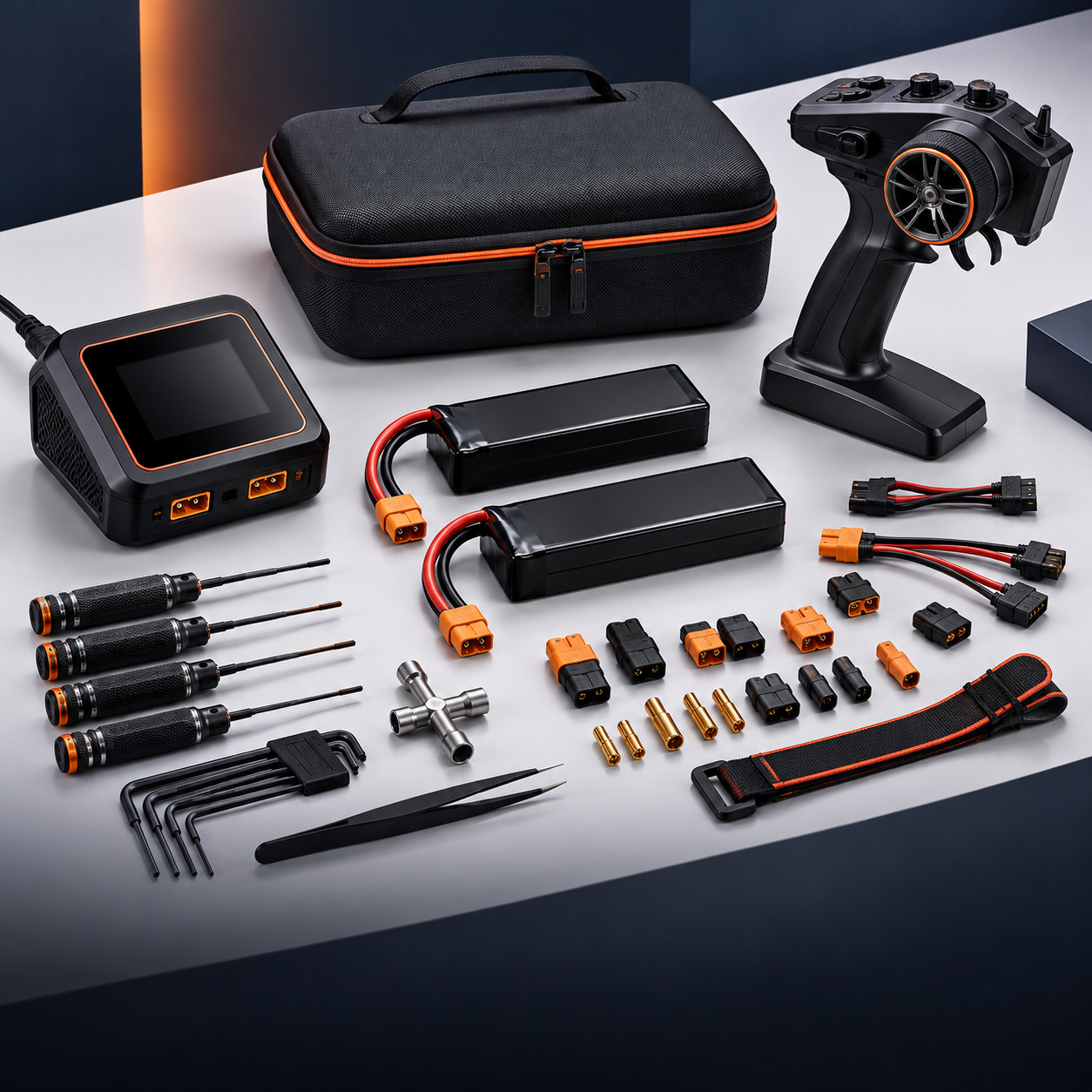
- Connections: Confirm the required main charging lead and balance connection, including any manufacturer-specific system.
- Adjustable current: Check the lowest setting as well as the maximum. A charger suitable for a large pack may not offer a low enough setting for a tiny battery.
- Output power: Check wattage as well as amps. Approximately 5A at 12.6V requires 63W of output; the charger and its power supply must support the intended combination.
- Power source: Confirm whether the charger accepts mains AC directly or requires a separate DC supply.
- Storage mode: This is useful for preparing supported lithium packs for time between runs.
Use balance charging for multi-cell LiPo batteries with the connections specified by the charger manufacturer. A USB-powered charger is not automatically suitable for every battery that physically plugs into it.
7. Set the charging current correctly
Follow the battery manufacturer’s charging limit. Where 1C charging is permitted, divide mAh by 1000 to obtain amps: 380mAh → 0.38A; 2200mAh → 2.2A; 5200mAh → 5.2A. These are examples, not approval to use those currents on an unidentified battery. A lower stated manufacturer limit takes priority.
Do not confuse a 90C discharge label with a 90C charge rate. Check the selected chemistry, cell count and current before starting each charge.
8. Running, charging and storage care
Use the appropriate low-voltage protection specified for your battery and ESC. Stop when protection activates; do not repeatedly restart to extract the last charge. A universal minimum voltage is not a substitute for the manufacturer’s cutoff instructions.
Let packs cool before recharging. Charge under supervision on a nonflammable surface away from combustible materials, using suitable fire-resistant containment. A charging bag does not make unattended charging safe. Stop using swollen, damaged or abnormally hot packs and arrange appropriate battery recycling.
For storage, disconnect the pack from the vehicle and follow its manufacturer’s instructions. Standard LiPo storage settings are commonly around 3.8V per cell; use the compatible charger’s storage programme rather than guessing a charge duration. Keep packs cool and dry, protect terminals against short circuits and avoid leaving them fully charged for extended periods.
Before you order
- Exact vehicle model and version confirmed.
- Battery chemistry and cell count approved.
- Tray dimensions, restraint and wire clearance checked.
- Main connector, balance connection and polarity verified.
- Capacity, weight and discharge capability suitable.
- Charger chemistry, current range, connections and power supply compatible.
Need help? Share the vehicle model, battery label, connector photographs and tray measurements with RC MEGA. We can help check the specification before you choose.
Browse batteries, chargers and charging accessories
Further reading
Always follow the manuals supplied with your equipment. General charging and care references: iFlight LiPo charging and storage guide and Traxxas EZ-Peak Plus charger instructions. Model-specific charger capabilities in those documents apply to the equipment they describe.
-
Posted in
Batteries, Buyer Guide, Chargers


